Governance
Calkit is a free, open-source, and openly-governed project. All issues and ideas are discussed publicly and are open to input from anyone. Because the project is still early-stage, the founder serves as the primary maintainer and decision maker. As the number of contributors grows, maintainers will be added to share review and release duties. The contributor's guide can be found here and our code of conduct can be found here.
Vision
We envision a future where reliable and impactful knowledge is created 10x faster than it is today. In this future nearly every research article is delivered as part of a single-button reproducible compendium (or "repro pack"). That is, all primary artifacts like source code and raw data are available, and all secondary artifacts like figures and article PDFs can be produced with a single command.
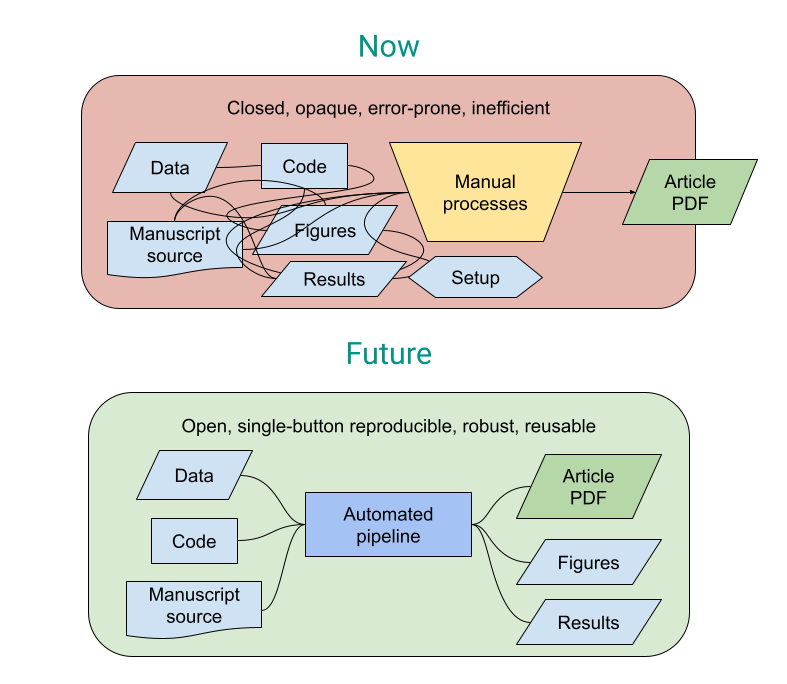
We believe that this will increase the pace of collective knowledge creation by enabling faster:
- Discovery of errors. Computational methods will be fully described and auditable.
- Replication. Studies can be replicated by simply replacing the raw input data and rerunning the pipeline.
- Extension. Innovation in science largely occurs at the level of hypotheses and conceptual models, not in mundane pipeline construction and execution. There is also a network effect as more types of single-button projects are published, making it easier to find something similar to a desired workflow to start from and adapt to new questions.
Most importantly, full automation speeds up iteration cycle time, and more iterations means greater likelihood of success.
The status quo
The figure below from the PLOS Open Science Indicators dataset shows how far away we are from our target. Code sharing rates are only ~10%, and of what is shared, it's reasonable to assume only ~10% of that code will even run, never mind be included in a complete, automated pipeline.
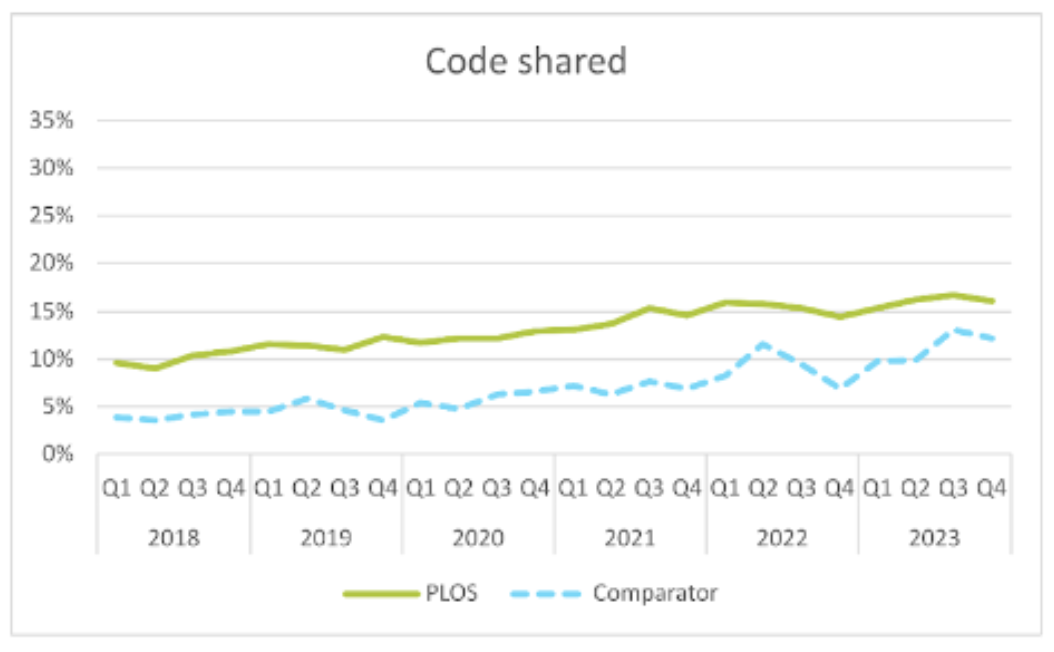
Code sharing rates from PLOS Open Science Indicators.
Strategy
Telling researchers they need to work reproducibly is like telling them they need to eat their vegetables. In other words, reproducibility needs to be a side effect of a process that is more productive and more enjoyable than the status quo.
The current "gold standard" requires researchers to become de facto software engineers, choosing and integrating multiple tools, designing bespoke project layouts and workflows. We want to provide a vertically-integrated, purpose-built, and user-friendly project format and toolset that reduces the required expertise and decision fatigue. That is not to say that policy, education, and support are not part of the solution—they certainly are—but we are focused on improving tooling and infrastructure.
- Path of least resistance: Make it faster to work in a clean, automated, reproducible way than it is to work in an ad-hoc, disorganized way.
- Intuitive tooling: Simplify the "hard parts" of modern scientific computing: caching, version control, and environment management. Instead of telling scientists to adapt software development tools for their science, build the tools that do the adaptation.
- Bridging the gap: Create a natural transition from interactive discovery (notebooks/shells) to automated batch pipelines.
- Builder's pride: Enable researchers to take pride in what they create so they will be more likely to share their projects openly.
- Continuous delivery: Continuous delivery (CD) practices have greatly enhanced the quality and speed at which software products are created. These same principles can be applied to research.
Objective and key results (OKRs)
2026-Q1
- Objective: Empower researchers to create and share single-button
reproducible research projects.
- Key result: 5 researchers (excluding direct collaborators) create single-button reproducible research projects this quarter.
- Key result: Of those who create projects, at least half share them openly and cite them in submitted articles.
- Key result: At least half of those who create projects agree that they would have been slower to finish (typically submit a paper) without Calkit.
Funding and sustainability
Calkit is committed to remaining free and open source forever. The project is sustained through a combination of:
- Volunteer contributions from the community.
- Institutional support through allocated work time.
- calkit.io optional paid plans to help cover infrastructure costs for the storage and compute service hosted at calkit.io.
The hosted service operates on a freemium model: a generous free tier for most users, with paid options for those who need additional storage or compute resources. This helps ensure the service remains available and reliable without requiring payment for typical research projects.
All Calkit software remains MIT-licensed and can be self-hosted and used with any compatible storage backend. In fact, we would prefer institutions host their own instance as part of a decentralized, federated network of hubs.